Words cannot describe how excited I got when I first saw
that they were releasing a movie version of the Les Miserables stage musical.
While I was aware that they’d already made movies based on Victor Hugo’s
famous novel, this one actually contained the songs from the musical. Since Les
Miserables is my all-time favorite musical, that instantly placed the
upcoming film on my must-see list, and I was very eager to see what they’d do
with this movie. Obviously, since the
movie is still in theaters at the time of this post, meaning it will be quite a
while before it’s released on DVD/Blu-ray, it’s not yet eligible for
review. However, I CAN review another
musical-turned-movie. While my love for
this movie musical isn’t as strong as my love for Les Miserables, the story
still holds a special place in my heart.
The movie I’m referring to is RENT.
Since this will be the first time I try to tackle a full-blown musical,
this review will be rather lengthy, as I’ll have a lot of ground to cover,
particularly when most of the story is told through musical numbers. Since I doubt anyone wants a blow-by-blow of
stuff that is either said or done within most of the musical numbers, I will do
my best to summarize what’s going on during the musical numbers in question.

My first
introduction to RENT happened when I was involved in high school chorus. One of the songs we were made to sing for one
of the school’s concerts was RENT’s infamous theme song ‘Seasons of Love,’ possibly
more commonly known as ‘Five Hundred
Twenty-Five Thousand Six Hundred Minutes.’
At that point in my life, I’d never even heard of RENT, and since it didn't even occur to me to actually do the necessary research on my own, (although, I probably wouldn't have been able to do much research anyway, as the school's internet filtering system, Bess, would have most likely blocked off all websites that had information on the story, due to the obvious subject matters of drugs, same-sex couples, and so on) I had
no clue what we were really singing about.
After I graduated high school and started taking classes at the local
community college, all thoughts of that song were cast off to the very edges of
my memory and I gave no thought to it again.
That is until 2004 came along, and my mother brought me to see Vanity Fair. (Incidentally, I probably should give that movie another chance
sometime. When I first saw it, the movie
held my interest for a while. But after
the jerky husband of the main character’s best friend dies in the Battle of
Waterloo, the film shifted into the movie version of the Energizer Bunny. It just kept on going, and going, and going,
and going….. I was sitting there
thinking ‘Come ON, movie. End already!” Maybe now that I’m older, I might enjoy it
more than I did back then, but that remains to be seen.)
Anyway,
getting back on topic, my mother and I were sitting in the dark theater
watching the trailers that preceded Vanity
Fair, and I started to hear a surprisingly familiar song coming out of the
theater’s speakers. Wouldn't you know it;
it was ‘Seasons of Love’, that song they made us sing in high school! As I stared at the screen in amazement, I
watched as a trailer for the movie version of RENT began to play. Needless to say, I was quite excited, and
immediately made a mental note to go see it, wanting to see the point behind
that odd song about midnights and cups of coffee. Unfortunately, after Vanity Fair ended and Mother and I left the theater, I didn't hear
a single word about RENT after that. I
saw no other trailers, and absolutely no TV spots. Thanks to what I ascribe to the poor
marketing, I completely forgot that the movie RENT existed. That is, until I transferred from the
community college to a four-year college roughly two hours away from my home
town. At this particular university,
there was a special movie night every Friday in the Student Union, where they’d
show movies that were no longer in theaters and hadn't made it to DVD yet. I happened to see that one of the movies they
were showing was RENT. Well, obviously,
this was a sign from above that I absolutely had to see this movie. Determined
not to let this chance pass me by again, I made sure I’d be in the designated auditorium
to watch it that Friday. Of course, when
the film first began, with eight nameless people standing up on stage singing
that infamous ‘Seasons of Love’ song, I was starting to wonder what exactly I
got myself into, and began thinking “Okay, I didn't just set aside two hours of
my life to watch these people just singing on a stage. Get on with the story.” However, when the actual story did get underway, I was very quickly
hooked, and when it ended, I was so enthralled in what I just saw, I was
positively giddy as I rode the shuttle bus back to my campus apartment. Not only that, RENT holds the honor of being
the first movie that actually made me cry.
That’s not to say that I’m hard-hearted when it comes to movies. I’ll admit that I did feel myself get choked
up a bit at the endings for Dragonheart, E.T. and Fox and the Hound. But RENT was the very first movie I ever saw
that made actual tears fall from my eyes.
So anyway,
the review. The film opens on, as I
mentioned above, that scene with the eight principal characters standing up on
stage, singing ‘Seasons of Love’. As you
might have gathered, I am not particularly thrilled with this scene. I suppose it was put in the movie for the
sake of the people who had already seen the stage musical or something. But I've seen the stage musical when the
touring cast came to my area, and while the actors do sing this song while just
standing on stage on one point, it’s at the start of Act 2 when everyone’s coming
back from intermission and need to get back into the show. But this isn't the stage musical, it’s a
movie. Seeing those people on stage does
not get you into the movie, it’ll just take you out of it. At least, that’s the effect it had on
me. For that reason, I personally think
that this wasn't a wise move on the part of the directors and script
writers. This opening scene just doesn't work in the movie, and to this day, it’s always the part I skip over
completely.
Once the
stage recital thing is finished, the actual story begins. The very first image we see is one of those
film countdown leader things, followed by various images from NYC. Although, the only recognizable landmark
that’s shown to us is the Radio City Music Hall. Most of the footage features shots of
homeless people. A disembodied voice informs
us that it’s December 24th, 1989, 9:00 PM EST, and that from this
point on, he’s shooting without a script in order to see if he can come up with
something good. This voice belongs to
Mark Cohen; an aspiring young filmmaker who we soon learn will film almost
everything he sees with a 16mm Bolex.
It’s clear to me that we’re supposed to conclude that the opening images
we saw were from Mark’s camera, which I have to say I find a rather artistic
opening for a movie. I tend to place
this opening right up there with the openings of the Indiana Jones films, when
that Paramount Mountain logo seamlessly becomes an actual mountain in the
movie. The only thing that would make
one scratch their heads is the fact that Mark will sometimes narrate while he
films with his Bolex camera. From the
quick research I've done on these cameras, they don’t actually record sound, so
they won’t pick up Mark’s narration. But
that’s probably just a nitpick, and I imagine Mark only really narrates to let
people know he’s filming them as some sort of courtesy to them.
As the
(real) opening song, ‘Rent’, is sung, Mark rides his bike back to his place,
which is known as the loft within the fan base, pedaling past a pole covered
with eviction notices. It is though this
song that we get our first look at some of the other main characters in this
movie. Back in the loft, we immediately
meet Roger, Mark’s best friend and roommate, who is busy with an acoustic
guitar. When the lights go out in the
loft, Roger immediately tries to fix the problem with the fuse box, but soon
learns that won’t do much, as Mark arrives home and shows him one of the
eviction notices. I’m guessing that
means that their power was actually shut off on them, but that’s not really
relevant right now. Roger and Mark then
immediately get a phone call from a payphone across the street. The caller is a man called Collins, Roger and
Mark’s other roommate, who is returning home after some time away. Mark tosses Collins down the key to get back
in the loft, but the second Mark ducks back inside, Collins is immediately
attacked and mugged by some street gang.
The song
continues as Roger and Mark try to keep warm by lighting a fire in an old
garbage can, using various posters and some of Mark’s discarded scripts to fuel
the fire. For some reason that I can’t
really understand, they then take the garbage can and dump the burning papers
over the side of the fire escape. I’ll
admit I really don’t understand their motivation for doing so. I mean, as Mark informed us right before this
song began, they’re in the middle of December in New York City, so it’s bound
to be cold. And with their power off,
they’d probably need that fire to keep from freezing to death and all. (I can speak from experience, as my house has lost power in the past due to wind and ice storms, and when the power, and therefore heat, is gone, the only way to keep warm is to bundle up in as many layers as possible and huddle in front of the fireplace.) I suppose Mark and Roger might have gotten caught
up in the moment or something, as we see other people who live on this street
are out on their fire escapes, too, and making a show of burning their own
eviction notices. So, maybe Mark and
Roger wanted to outdo their neighbors? I
don’t know.
Anyway, we then meet Benny,
who has just driven up in his Range Rover.
He calls up to Mark and Roger, instructing them to come down so he can
talk to them. They wordlessly agree, but
before Roger can follow Mark off the fire escape, he happens to meet the eyes
of a young girl living on the floor below them.
It's now time for some exposition. With the help of Mark’s trademark
narration as he films Benny, we learn that Benny married a woman named Allison
Grey, whose rich father owns many buildings on the block. In addition, Benny apparently is planning to
evict many of the homeless from this neighborhood known as Alphabet City so he
can build a Cyber Studio. It’s here that
we also learn, though a comment Benny makes, that Roger is a recovering drug
addict. Roger, obviously not wanting to
beat around the bush, asks Benny straight out why he’s there. Benny explains that his father-in-law heard
about a protest against the Cyber Studio, which is being held by a woman named
Maureen. Here, it’s also revealed that
Mark once dated Maureen, but she recently dumped him for a lawyer named Joanne.
In retaliation of Maureen’s protest,
Mr. Grey sent Benny out to Alphabet City to collect the rent money. Mark and Roger immediacy react with
annoyance. Now, I’ve seen some people
criticizing Mark and Roger here, saying that they’re essentially lazy bums
because they’re mad at Benny for asking for the rent money. That’s not why they’re angry, people. They’re angry because when Benny bought the
building Mark and Roger live in after marrying Allison, he had promised them
that they could stay there rent free.
Now, he’s showing up on Christmas Eve asking for an entire year’s worth
of rent money. Who wouldn't be angry?
Anyway,
Benny presents Mark and Roger with a deal.
He will keep his promise to allow them to stay there rent free if, and
only if, they manage to stop Maureen’s protest.
Actually, now that I think about it, I am a bit confused about the
motivation of Benny and the Greys. I
mean, I do sort of understand their reasons for wanting to build a Cyber
Studio. As Benny explains with his
signature musical number, ‘You’ll See’, this Cyber Studio would enable people
like Mark and Roger to continue their passions (filmmaking and songwriting
respectfully) and actually get paid for it.
In other words, he’s creating new job opportunities for people. However, when the people who live on the site
of the proposed Cyber Studio react negatively to getting evicted, with a
full-blown protest being held, Benny and the Greys get all huffy. I mean, you’re essentially kicking a bunch of
people out of their homes so you could build your precious Cyber studio. Of course they’re going to protest.
The movie
now introduces us to our next protagonist, Angel. While sharp eyes will catch a quick glimpse
of this character at the conclusion of the musical number ‘Rent,’ the real
introduction to this character has him/her (this label will make sense later)
sitting on a street corner drumming away on an empty pickle tub for money. When he/she hears someone coughing in a
nearby alleyway, he/she goes to investigate and finds an injured Collins, who
as I've mentioned had just been mugged.
After Angel and Collins introduce themselves, Angel helps Collins to his
feet and helps him walk out of the alleyway, offering to help clean him up a
bit. He/she tells Collins that he/she
does sort have to hurry, as he/she has a life support meeting to go to. This life support meeting is for people
infected with HIV, something Angel and Collins both admit to having.
Here, we
cut back to Mark and Roger, who are back in the loft. Roger is back to fiddling around with his
guitar when Mark announces that he’s stepping out to see if he can find out
what happened to Collins. (Remember that
Mark last saw Collins when he threw the key to the loft down to him, and isn't even aware that his friend was mugged immediately afterward.) Mark asks Roger if he wants to come along to
help him look, but Roger refuses. Mark doesn't push Roger to change his mind, but simply reminds Roger to take his
AZT, revealing that Roger also has HIV.
After Mark leaves, we get our next musical number, ‘One Song Glory’, in
which Roger expresses his desire to write one phenomenal song in order to leave
behind some legacy before his inevitable death.
As this song is sung, we get a series of flashbacks that show that Roger
was once a singer in a band. At one of
his gigs, his eyes meet those of a red-headed girl named April, and the two
quickly become romantically involved.
However, April either was already involved in or started taking heroin,
and it’s implied that she got Roger to start taking it as well. Because April apparently shot up with a
contaminated needle, she became infected with HIV. This also explains how Roger must have gotten
the virus, too, as he probably either shared needles with April or caught it
through sexual contact with her. As for
April, Roger admits that she died a little later on. While it’s never stated how she died in the
movie, the stage musical explains that she committed suicide by cutting her
wrists in the bathtub after learning of her diagnosis. And again, while it’s never actually stated,
it’s heavy implied that Roger not only quit heroin after April’s death, he hasn't left the loft since then, because all he can see is the fact that he’s going
to die before his time and therefore doesn't see the point of actually living. Wait!
I just caught something! Earlier,
Benny commented how Roger was looking good after coming off a year of
withdrawal. Maybe he wasn't just
referring to the heroin withdrawal.
Maybe he also meant a withdrawal from life! Poignancy for the win!
After
Roger’s soliloquy ends, he gets a surprise visit from that girl who he noticed
earlier, the one who lives on the floor below.
Though another musical number, ‘Light My Candle’, this girl explains
that the heat in her place downstairs was also turned off, and requests Roger’s
help in lighting the candle she brought up.
Although, we saw right before she knocked on Roger’s door that the
candle had already been lit until she purposely blew it out, so we know that
this girl is simply using that candle as an excuse to come up and talk to
Roger. Throughout this song, there are a
number of nuances that show that there’s an instant connection between Roger
and this girl. For example, when Roger
notices that this girl is shivering, he immediately whips off his leather
jacket and puts it around her shoulders, trying to provide her with an
improvised blanket.  Roger insists he’s
seen this girl somewhere before, but he just can’t place where until she states
that she dances at an S&M club known as the Cat Scratch club. Obviously, this girl must have made quite an
impression on Roger when he saw her at this club, as he remembers her after
being shut away for a year. Anyway, as this
musical number continues, we see this girl playfully flirt with Roger, with
Roger acting completely flustered about the whole thing, which of course
further shows that he’s completely blown away by her. This song number also reveals the girl is an
active heroin addict when she realizes she dropped her stash of drugs while she
was talking to Roger and proceeds to search the room for it, all while Roger
tells her that she should really quit taking heroin. (This will be a pretty big plot point later
on.) As this song number ends, the girl
introduces herself to Roger, stating that people call her Mimi.
Roger insists he’s
seen this girl somewhere before, but he just can’t place where until she states
that she dances at an S&M club known as the Cat Scratch club. Obviously, this girl must have made quite an
impression on Roger when he saw her at this club, as he remembers her after
being shut away for a year. Anyway, as this
musical number continues, we see this girl playfully flirt with Roger, with
Roger acting completely flustered about the whole thing, which of course
further shows that he’s completely blown away by her. This song number also reveals the girl is an
active heroin addict when she realizes she dropped her stash of drugs while she
was talking to Roger and proceeds to search the room for it, all while Roger
tells her that she should really quit taking heroin. (This will be a pretty big plot point later
on.) As this song number ends, the girl
introduces herself to Roger, stating that people call her Mimi.
Roger insists he’s
seen this girl somewhere before, but he just can’t place where until she states
that she dances at an S&M club known as the Cat Scratch club. Obviously, this girl must have made quite an
impression on Roger when he saw her at this club, as he remembers her after
being shut away for a year. Anyway, as this
musical number continues, we see this girl playfully flirt with Roger, with
Roger acting completely flustered about the whole thing, which of course
further shows that he’s completely blown away by her. This song number also reveals the girl is an
active heroin addict when she realizes she dropped her stash of drugs while she
was talking to Roger and proceeds to search the room for it, all while Roger
tells her that she should really quit taking heroin. (This will be a pretty big plot point later
on.) As this song number ends, the girl
introduces herself to Roger, stating that people call her Mimi.
We then cut
to morning, Christmas Day. The power is
back on in the loft, and as Roger pours himself some coffee while reading a
newspaper called The Village Voice,
Mark is screening a phone call from his mother.
And on a personal note, there are not enough words to describe how much
I dig Mark and Roger’s answering machine message. You know how most people have their messages
say stuff like ‘we can’t come to the phone right now, so wait for the beep, you
know the drill.’ Well, Mark and Roger,
like a regular pair of smart alecs, have recorded their message as a monotone
command of ‘Speak!’ in the same manner as the characteristic answering machine
beep. Even to this day, hearing that
answering machine message gets a chuckle out of me.
Anyway,
while Mark’s mother doesn't say anything really awful in her phone call, and
it’s clear that she loves her son, there is that certain undertone in her phone
call that paints Mama Cohen as one of those overly-doting mothers. You know, the type that calls up their adult
children every week to check if they still have clean underwear? After the phone call ends, Roger happens to
glance over at the window and sees that Mimi has written him a message in the
frost covering the glass, inviting him to a Christmas brunch in her pad
downstairs. While his facial expression
betrays the fact that he’s tempted, when Mark asks him if he’s going to accept
the invite, Roger immediately says he’s not.
Now, before people start trying to judge Roger too harshly because of
this, please keep in mind that he’s essentially refused to leave the loft in
over a year, and that he can’t bring himself to live his life because of the
knowledge that he carries a rather serious illness that may very well kill
him. In addition, he’s probably afraid that
if he lets himself get close to Mimi, he might end up infecting her with the
virus. That or he’s cautious about Mimi
being a heroin addict and is worried that he might fall off the wagon if he
spends time with her. Personally, I
think it’s more of the former than the latter.
But I digress.
At that
moment, Collins enters the loft and is promptly welcomed back by Mark and
Roger. Collins presents them both with
Stoli in disposable paper cups and some food (not exactly what sort of food he
brings over, but it almost looks like cheeses and such) before informing his
roommates that he has returned home from his teaching job at MIT after being
fired for some reason. (The reason will briefly be mentioned in another musical
number later on, but I’ll get to that later.)
However, he has a new teaching job at NYU. When Mark asks if that’s how he was able to
afford the alcohol and food he brought home with him, Collins states that it wasn't him who brought that stuff, but it was in fact Angel, the person who had helped
him after being mugged. He then opens up
the loft door to reveal Angel standing outside. (So, was Angel just standing
outside this whole time, waiting for Collins to introduce him/her with as much
fanfare as possible? Guys, I’m starting to think this movie might be a bit
weird.)
Anyway,
Angel is now dressed as a girl, with a Santa Claus-esque dress and a black
wig. This is the reason for me giving
this character the he/she label. Angel, it turns out, is either a transvestite
or a drag queen. It’s never really stated which one, but either way, Angel is physically a boy, but is most
often seen dressed as a woman. For that
reason, Angel wears the whole he/she label proudly. With the use of the musical number ‘Today 4
U, Tomorrow 4 Me’, Angel informs Mark and Roger that some rich lady paid Angel
$1,000 to play his/her drums in front of a Gracie Mews apartment building,
where the rich lady’s neighbors live with an Akita called Evita. This particular dog’s incessant barking is
keeping the rich lady up at night, so the rich lady is hoping that if Angel
plays his/her drums outside, the dog will bark herself to death. Apparently, the plan worked better than
expected, as Angel’s drumming got Evita so wiled up, she actually fell from the
window of the 23 story apartment and plummeted to her death.
After the
song ends, someone else calls the loft.
This time, it’s Maureen, that woman who’s holding the protest against
Benny’s Cyber Studio, and who dumped Mark for Joanne the lawyer. The reason for Maureen’s phone call is
because she wants Mark’s help in setting up her protest. Mark is not happy that Maureen is asking for
his help in fixing her sound equipment after dumping him for a woman, but he
decides to go over to do what he can.
Collins and Angel also make their exit so they can go to that life
support meeting, the one that had been formed for people with HIV. They invite Roger to go, but like before, he
turns down the invite, still refusing to leave the loft.
Down at the
performance space, Mark arrives to help fix Maureen’s sound equipment, but
finds that Maureen isn't even there.
Instead, he has his very first encounter with the infamous Joanne. The pair immediately have a whole awkward
Mrs.-and-the-Ex moment before launching into another musical number, ‘The Tango
Maureen’. Through this musical number, which
includes a whole dream sequence with a good number of random couples performing
the tango all over the room, Mark and Joanne form a bond-of-sorts over their
mutual knowledge of Maureen’s flighty, flirtatious nature. After fixing Maureen’s sound equipment, Mark
heads across town to a community center.
This is the meeting place for the life support meeting Collins and Angel
are attending, which Angel had told him he was welcome to come to as it wasn't just for people with HIV/AIDS. This
scene is rather short, but it does introduce us to one of the movie’s recurring
themes, about not letting past regrets stop you from living your life by using
the movie’s catchphrase: No Day But Today.
Immediately,
we shift focus to the Cat Scratch Club, where Mimi is currently putting on a
show for the club’s patrons. Throughout
this scene, Mimi sings the next musical number, ‘Out Tonight’. There’s not much that really happens during
this song. It’s essentially just Mimi
moving about on stage, taking money from the club’s patrons and getting into
various provocative positions before walking home from the club. (But if you look carefully, I swear you can
see Albert Einstein’s long-lost twin brother in the crowd.) Basically, this is the movie’s party
song. The song that doesn't have any
real message, but talks about having a fun night out on the town. Anyway, as ‘Out Tonight’ comes to an end,
Mimi arrives at her apartment but then immediately makes her way up to the loft
to see Roger, who is still messing around with his guitar. Roger, while he is clearly stunned to see her
climbing in through his window like she owns the place, a brief smile does
flash across his face, and when Mimi moves in to kiss him, you do see him give
in to her kiss for a few moments. 
However, Roger quickly pulls away and we immediately shift into the next song, ‘Another Day’. In this song, Roger berates Mimi for barging in and tells her to leave. While he teeters on the edge of explaining his reasons for pushing her away, he quickly decides against it. Mimi tries to convince Roger to take a chance, repeating the message we just heard at the life support meeting: life is short, so don’t let regret stop you from living. Roger, however, refuses to listen to Mimi and pretty much throws her out of the loft, telling her to leave him alone. This eventually leads to what is essentially a shouting match between Roger and Mimi, which Mark, Angel and Collins end up witnessing as they return from the life support meeting.
However, Roger quickly pulls away and we immediately shift into the next song, ‘Another Day’. In this song, Roger berates Mimi for barging in and tells her to leave. While he teeters on the edge of explaining his reasons for pushing her away, he quickly decides against it. Mimi tries to convince Roger to take a chance, repeating the message we just heard at the life support meeting: life is short, so don’t let regret stop you from living. Roger, however, refuses to listen to Mimi and pretty much throws her out of the loft, telling her to leave him alone. This eventually leads to what is essentially a shouting match between Roger and Mimi, which Mark, Angel and Collins end up witnessing as they return from the life support meeting.
The next
morning, Mark tries to bring up the fight Roger had with Mimi, but Roger states
he doesn't want to talk about it. Trying
another tactic, Mark announces that Mimi will be at Maureen’s protest, which is
being held that night. He proceeds to
try and convince Roger that being with Mimi might be good for him, as she might
help him learn to live again. However,
Roger once again brushes Mark’s advice off.
Realizing he’s probably not going to win this one, Mark exits the loft,
leaving Roger alone with his thoughts.
Across town, Mark is once again at the life support meeting with Collins
and Angel. You know, I can’t help
wondering how many times they hold these life support meetings. In the movie’s timeline, this is the third
consecutive day. I mean, with Alcoholics
Anonymous, the meetings are typically once a week, aren't they? So why is this HIV/AIDS group meeting three
days in a row? Is this life support
group regularly a daily thing, or did they just temporarily schedule it like
this because it’s Christmas, a time when people usually need to feel connected
to one another all the more? But I guess
I’m getting off the track again.
As Mark
films the meeting for the documentary he’s working on, he is stunned to see
someone else walking into the room. It’s
Roger, who apparently has finally been convinced to step outside the loft for
the first time since April’s death a year ago.
Mark, Collins and Angel are all pleased and proud to see Roger
there. When the four friends leave the meeting,
Mark stops a couple of cops from harassing a homeless woman, but the woman
thanks Mark for his help by practically biting Mark’s head off. After this confrontation, they get on a
subway train where Collins and Angel sing the next song in this musical film,
‘Santa Fe,’ a song about their dreams to leave New York and move to Santa Fe in
order to open up a restaurant. Again, I
might be reading something into nothing, but what is it about Santa Fe that’s
so attractive? This isn't the first
time I've seen a movie with people living in New York wanting to leave for
Santa Fe. In the Disney musical Newsies, the main character Jack Kelly
also had a whole song about his wish to leave New York and starting again in
Santa Fe. Seriously, why is Santa Fe so
attractive to New Yorkers? Mind you, I’m
sure New York is a rough place to live. I've heard all the stories about the mugging and the homeless community
and all the other negative aspects about the Big Apple But even so, why Santa
Fe? Why not Florida or some other warmer
place? I just don’t get it.
When their
subway train ride comes to an end, Mark steps away to continue helping set up
Maureen’s protest, dragging Roger with him.
Once Collins and Angel are alone, they launch into another song, this one
entitled ‘I’ll Cover You’. Like ‘Out
Tonight’, this song doesn't really serve much purpose in the overall movie, but
it does reveal that Collins and Angel have both fallen for each other. Now, when I saw this movie for the first time,
my reaction was essentially ‘Wha?!
They’re gay?’ I’ll admit
that it’s nice they didn't make the sexual preference of these two characters
all in-your-face and brutally obvious by utilizing any of those stereotypical
behaviors by making them both all effeminate and obsessed with curtains and whatnot. Nevertheless, this plot point just seemed to come
completely out of nowhere. When I first
watched this movie back at that four-year college, I had absolutely no clue
that Collins and Angel were gay/homosexual/whatever the current PC term is
before this song popped up, so their mutual decision to become lovers caught me
completely off guard. Sure, Collins did
cast a few glances at Angel a few times earlier on in the movie, but if you didn't already know that they’d enter into a romantic relationship with each
other, those glances would have been very easy to overlook. Granted there’s a little more build up to
this in the stage musical, but not much.

So, yeah, Collins and Angel are in
love now, and even engage in a full-on lip-lock. Okay, I guess I can accept that, even though
I still think it came completely out
of left field. After that point has been
made, we fast forward to nighttime, where we see a brief shot of the New York
skyline, with our eyes instinctively being drawn to the iconic Twin Towers.
(Remember this movie is set in 1989, over a decade before the famous
tragedy.) Once we've all been given the
chance to stand and salute those poor towers and everything they stand for, the
movie returns our focus to the protagonists, just in time for Maureen’s protest
to start. Roger is standing outside the
performance space, searching, as it’s quickly established, for Mimi. He soon spots her, but he sees her standing
with someone he recognizes: the same drug dealer who April used to buy her
heroin from. However, Roger manages to
shrug off this coincidence and approaches Mimi.
When he tries to ask her if they can talk, the drug dealer, known to the
fans simply as The Man, steps in and threatens Roger, warning him not to steal
his client. Roger retaliates by shoving
The Man, angrily stating that The Man didn't miss him, so he most likely won’t
miss Mimi, also pointing out that he’s got plenty of customers. Not wanting the confrontation to escalate,
Mimi pulls Roger aside, allowing Roger to apologize to her for the other
night. He offers to try and make it up
to her by telling her that he and his friends are going to the Life Café after
Maureen’s show, and inviting her to come along as his date. With a smile, Mimi accepts the invite and
then accompanies Roger into the performance space, where they meet up with
Collins and Angel. At that moment,
Maureen arrives, riding in on a motorcycle to begin her protest, with the next
song, ‘Over the Moon’. This ‘song’ is…
just weird. While the ‘Seasons of Love’
scene is the one I tend to skip over, this is the one when my brain zones
out. ‘Over the Moon’ is like an
interpretive art exhibit combined with a student film. I can sort of tell that Maureen is trying to
discuss what’s happening with Benny and his Cyber Studio, and the threat of
everyone being evicted, but her methods of doing so are just bizarre with her
constant references to that old nursery rhyme, Hey Diddle Diddle, with heavy emphasis on the cow with super jumping powers. The only thing that really stands out to me
during this scene is when Maureen brings everyone’s attention to the fact that
Benny is standing among the crowd, and there’s a brief camera shot of Mimi
looking slightly uncomfortable. But we
won’t learn what that’s about until later on.
At one
point during Maureen’s protest, everyone suddenly starts mooing, which makes
this whole sequence even more weird. But
that’s when the police, who had been called in by Benny to be on stand-by, step
in and try to force some of the protesters to back away from the stage. Despite Maureen’s efforts to break things up and keep everything peaceful,
her attempts ultimately fail as a full-on riot erupts. In an attempt to avoid trouble, Roger, Mimi,
Collins and Angel all hightail it out of there.
Sometime
later, Maureen and Joanne are seen walking up to the Life Café, with Maureen
venting her annoyance with Benny for placing the cops at her protest to begin
with, particularly because a good number of the protesters got arrested. Joanne reassures Maureen that the cops will
most likely let everyone go in a couple of hours. Once they reach the Life Café, they are
immediately met with Collins, Angel, Mimi and Roger. It’s only then that they realize that Mark’s
not there. They decide to wait for him
inside, which is kind of odd if you ask me, particularly because everyone knew
Mark had been at the protest, too. For
all they knew, Mark might have been among the people who got arrested, or he
could have gotten seriously hurt in the riot. But
maybe they were trying to be hopefully optimistic that he just got hung up
somewhere and are giving him a few more minutes to get there before breaking up
into search parties. Thankfully, Mark wasn't in trouble after all, as he enters the Life Café a short time
later. He announces that some news
station had bought his footage of the riot that had erupted at Maureen’s
protest, and that they’ll be showing it that night at 11:00. After a rather humorous exchange with the Maitre'd, the seven friends join up with some other
nameless people, who they all clearly know somehow. Before sitting down, Maureen notices that Benny
is also there at the Life Café, having a meeting with Mr. Grey and some other nameless
business associate. The main group
starts to tell Benny off for showing his face there after what just happened,
but Benny tries to explain that he never wanted things to get out of hand. Everyone ignores Benny’s attempts, and Roger
asks Benny why his wife, Allison, missed the protest, snidely referring to her
as Muffy. Benny replies that there was a
death in the family: their pet Akita.
Instantly, Roger, Mark and the others realize that Benny is referring to
Evita, the same dog that Angel admitted to essentially killing earlier in the
film.
Once again,
Benny tries to get everyone, here on in referred to as the Bohemians, to see
things from his point of view, stating that he’s trying to do some good He finishes off by informing them they’ll end
up getting nowhere by clinging to their ideals so strongly. In response, Mark leads the others into the
song ‘La Vie Boheme’, which is essentially the Bohemians pledging to continue
living as nonconformists, making as many references as possible to various
artists, poets and subjects that are essentially taboo in polite society. Their display alienates Mr. Grey and the
nameless businessman so much they leave without a word, with Benny tailing
after them. 
As the Bohemians continue to
celebrate, with Angel finally stating why Collins was fired from MIT (he
somehow wired some of the school’s electrical equipment to self-destruct as
some sort of anarchist statement about fighting AIDS), Mimi approaches Roger,
informing him that she’s annoyed that, even though he invited her to come to
the Life Café with him, he’s been ignoring her all night. Again, Roger tries to apologize, stating that
he has been trying, and that he’s got baggage.
As Mimi tries to tell him that she’s okay with baggage, as she has some
of her own, Roger is momentarily distracted when his beeper goes off. This beeper, from what I gather, is issued to
people with HIV to remind them to take their AZT. Suddenly, to Roger’s amazement, he sees Mimi
also pulling out some AZT of her own, revealing that she also has HIV. As was stated earlier in this review, Roger
was pushing Mimi away mainly out of fear that he could infect her with the
virus. But now that he knows that she’d
already had it, he doesn't have to worry about that anymore, and is perfectly
free to let himself be with her.
And it’s
here that we get Roger and Mimi’s signature love song, which begins after Roger
leads Mimi outside into a snowy back alley. (Interesting choice of location,
considering he just found out that she has a disease that essentially attacks
her immune system, and that cold weather tends to further hinder a person’s
immunity against illness. But that small
nitpick aside, this remains one of my favorite scenes in the movie.) Within
this song, ‘I Should Tell You’, Roger and Mimi basically try to express their
growing attraction for each other. In
general, the lyrics to this song are a bit intelligible and don’t make a lot of
sense when you really take the time to listen to them, but I think that’s the
point. When has love ever really made
sense? You just agree to throw caution
to the winds and take a chance, and that’s exactly what Roger and Mimi are
doing here. Neither of them really have
any idea where their relationship will go, but they’re both deciding to give it
a chance. After Roger cements things by
kissing Mimi, they go back inside the Life Café where the Bohemians are
continuing their celebration. .
.
.
We now get
to watch a montage of Mark’s random footage, over a short segment of ‘Seasons
of Love’. Again, this is why I think that
opening sequence doesn’t really work within the movie. In the stage musical, this is where ‘Seasons
of Love’ is performed, and since it’s still appearing here in the exact same
spot, putting it at the beginning as well seems to be a bit of an odd
decision. (I’m sorry, but I can’t get
past the stage thing. What was up with
that?)
When the montage ends, the
Bohemians are celebrating New Years.
After Mark asks Roger and Mimi what their New Year’s Resolutions are, he
then gets into a conversation with Maureen.
Through this conversation, we learn that Mark was offered a job with a
news show called Buzzline, but Mark is completely uninterested in the offer,
stating that he’d be selling out if he goes to work for Buzzline.
When the
Bohemians return to the loft, they discover that Benny has had the building’s
doors padlocked shut. With Angel’s help,
they manage to break the padlock and walk in.
But upon reaching the loft, they discover that Benny didn’t just stop
with the padlocked door, he also completely cleaned out their place, removing
all of their belongings. Mimi enters the
loft, stating that Benny also completely cleaned out her pad. Joanne, utilizing her lawyer knowledge,
informs everyone that now that they’re inside the building, they’re all
technically squatters. Therefore, they
can’t be arrested or thrown out onto the street. This, according to Joanne, should enable them
time to get some money together. The
problem is, how are they going to get money when Mark and Roger don’t have any
income to speak of? With a casual shrug,
Maureen reminds Mark that he could always go work for Buzzline. Realizing that he no longer has much of a choice,
Mark reluctantly agrees and arranges a meeting with Alexi Darling, the head of
Buzzline. Joanne, who obviously is friends with Mark now, accompanies him to
the meeting as an agent-of-sorts. In the
end, it is agreed that Mark will come work for Buzzline, who will pay him $3,00
per segment, but during the meeting, Joanne witnesses Maureen, who had tagged
along, essentially flirting with a secretary.
This does not make Joanne happy at all, and as they leave the office
building, Joanne tells Maureen off for flirting with some other woman. Maureen insists that she was just being
friendly. As the pair continues to
argue, Joanne informs Maureen that what she wants the most from her is
commitment. Maureen shows no sign of
being phased by this, and they instantly decide to get engaged on the spot,
paying no attention to poor Mark, who is simply watching everything transpiring
like a stunned beast.
The action
shifts to some hoity-toity country club, where Maureen and Joanne’s families
have come together to celebrate the engagement.
However, a leopard, as they say, cannot change their spots. At least not overnight. As Joanne is hugged and congratulated by the
Bohemians, she once again notices that Maureen is across the room, acting
rather flirtatious with a woman working at the country club’s bar. Joanne promptly pulls Maureen aside, begging
her not to act like that, especially not today.
Faster than you can blink, an argument is triggered between Maureen and
Joanne, which quickly escalates into a fight that draws everyone’s
attention. Throughout this fight, which
occurs through the song ‘Take Me As I Am’, both Maureen and Joanne inform the
other that neither of them can change who they are and, if they can’t live with
each other’s faults, namely Maureen’s constant need to be the center of
attention and Joanne’s rigid, unyielding nature, then maybe they shouldn't be
together after all. The fight ends with
Maureen and Joanne deciding to break up, and both women storm out of the room,
prompting Maureen’s mother, in a moment of comic relief, to hopefully suggest
that maybe her daughter can get back together with Mark now.
After
Maureen and Joanne’s public break-up, Mark, Roger, Mimi, Collins and Angel
return home to the loft. Upon entering,
they find that not only has all their stuff been brought back, Benny is also
waiting there for them. He informs them
that Mimi, whom he hasn't seen in a while, had met him for dinner and that she
convinced him to rethink the situation.
Upon hearing this news, Roger is immediately on guard, which indicates
that Mimi failed to inform him about this meeting. With no indication that he notices the sudden
tension between Roger and Mimi, Benny proceeds to announce that he’s willing to
make a new deal with his former friends, and presents them with a brand new
lease, courtesy of Cyber Arts. Mark
informs Benny that they don’t need his charity, and hands over his first
advance from Buzzline. Benny, undoubtedly
realizing that he’s overstayed his welcome, promptly exits the loft. After Benny leaves, Mimi cautiously walks up
to Roger, informing him that while nothing happened during her recent meeting
with Benny, they did indeed date at one point (which explains that awkward
expression that appeared on her face during the ‘Over the Moon’ segment), but
it was over two years ago, long before she’d even met Roger. Roger insists that he doesn't care and gives
her the cold shoulder. Thus, we've now
got two of the movie’s couples going through a rough patch.
Now, I've put a lot of thought into trying to understand the reasons for Roger distancing
himself from Mimi at this point, and I think I've got it figured out. It’s already been established that Roger
clearly had no idea Mimi had met with Benny, so she obviously arranged the
meeting behind Roger’s back. So, right
there, we have a breach of trust. In
addition, Benny said that he met Mimi for dinner and she “convinced [him] to
rethink the situation.” While this does
seem like a rather innocent statement, the fact remains that there are some
people in this world who will say “why don’t we have dinner together” when what
they really mean is “come and sleep with me” (i.e. that Charles Caiman bloke
from Godzilla ’98.) So, is that what
we’re supposed to assume Benny’s implying in this movie? Well, in the movie’s current format, I
suppose that’s pretty much open to debate, but in the stage musical version,
Benny does make a pronounced effort to make it sound like Mimi willingly
seduced him. And, in one of the movie’s
deleted scenes, Benny does make a snide comment to Roger about how Mimi can be
very persuasive, which can easily be interpreted the wrong way. So, if we accept that this deleted scene
actually happened within the movie’s reality, we can conclude that Benny has
intentionally placed a seed of doubt in Roger’s head, forcing him to question
Mimi’s fidelity.
Time once
again passes through a rather packed montage, accompanied by the song ‘Without
You’. This montage covers a lot of
events that occur within the lives of the Bohemians over the following months, so I’ll try to sum it up
as best as I can. Roger, possibly having
calmed down enough to try and talk out their issues with Mimi, enters her
apartment only to find her seconds away from shooting up. In disgust, he walks out without a word. Realizing that she has to make a choice
between Roger or the heroin, Mimi decides to try and quit. Roger later finds Mimi going through what
looks like a rather painful withdrawal and promptly carries her up to the loft,
showering with encouragement and holding her as tight as he can. However, Mimi eventually falls off the
bandwagon and is then shown outside the Cat Scratch Club, buying more heroin
from The Man. As Mimi turns around after
completing her transaction, she is horrified to find that Roger had seen the
whole thing. Even though we can’t really
hear what Roger and Mimi are saying to each other after Roger catches Mimi
buying more drugs, as the song playing during the montage drowns them out, it’s
pretty clear that Roger officially ends things with Mimi, as he throws the
heroin back at her and walks off without looking back. Meanwhile, we see various shots of the life support
meetings, which Roger and Mimi both attend now.
One-by-one, we see some of the life support members fading out of the
picture, which I guess is meant to symbolize that the members in question have
passed away due to an AIDS related illness.
As the camera finally comes to focus on Collins and Angel during their life
support meeting, the scene immediately shifts to a subway train, where Collins
is holding a clearly-ill Angel. The
montage continues to show Angel is now confined to a hospital bed as his/her
condition grows worse and worse. (Maureen
and Joanne also appear in this montage, in the scene when the Bohemians are all
visiting Angel at the hospital. As their
facial expressions and body language indicate, these two aren't even speaking
to each other anymore.) As the montage
ends, we are left with the image of Collins crying over Angel’s still body,
letting us know that he/she has passed away, a fact that is further driven home
when the next scene shows everyone attending Angel’s funeral service on
Halloween, complete with a reprise of ‘I’ll Cover You’, the song Angel and
Collins had previously used to announce their undying love for each other.
As Angel’s
funeral ends, with the Bohemians starting to leave the cemetery, Mimi
hesitantly tries to talk to Roger, asking him if it’s true that he sold his
guitar and used the money to buy a car in order to leave New York. Roger confirms this, stating that he’s
leaving that very day for Santa Fe. He
then tells Mimi off for having Benny accompany her to Angel’s funeral. For reasons that I can’t even begin to
comprehend, Benny decides that now’s a good time to remind Mimi that she said
that she wasn't going to speak to Roger again.
When Maureen berates Benny for acting like he has any say in who Mimi
talks to, Joanne interrupts by telling Maureen to mind her own business. With that, a huge fight erupts between
Maureen and Joanne & Mimi and Roger, with neither pair paying any attention
to Mark and Benny as they try to break up the fights. Although, to be fair, it’s not really much of
a fight in terms of Maureen and Joanne.
With them, Maureen is just standing there without saying a word while
Joanne shouts about how Maureen never put any real effort into their
relationship. Mimi and Roger, on the
other hand, both have things to say to each other. Mimi calls Roger out on how he was never
really committed to their relationship while Roger yells at Mimi about her
ongoing heroin addiction. Plus, he still isn't completely convinced that Mimi didn't cheat on him with Benny. It’s only when Collins steps in that the
fights end abruptly, with Collins reminding them all that they’d promised they wouldn't bring up any of their personal grievances up today, out of respect for
Angel. He then states that he can't believe that their family is now breaking apart, particularly after Angel
worked so hard to help them all believe in love. While Collins’ words seem to reach Maureen
and Joanne, as Maureen moves in to comfort a crying Joanne, Roger proceeds to
leave the cemetery without sparing a glance at Mimi.
After Roger
leaves, we get our next montage song, ‘What You Own,’ which focuses on Mark
and Roger. Mark continues to work at
Buzzline, but is finding that he’s not getting any inspiration for the
documentary he’s been working throughout the course of the movie. It’s not from lack of trying, as he spends
nearly every spare moment reviewing the various footage he’s collected, with the
voice of Angel, who is apparently his muse now, ringing in his ears. As for Roger, he makes it to Santa Fe, where
he sells the car that brought him there to buy a brand new guitar. (So, why not
just buy a bus ticket if you were going to resell the car and buy another
guitar? Are you telling me that buying a
car and spending money at the various gas stations along the way is cheaper
than a bus ticket?) Confusing monetary
decisions aside, Roger starts working to earn money by being one of those
street performers. However, he quickly
finds that he’s being haunted by Mimi, with him constantly seeing her face
everywhere. As time goes by, both boys
come to realize that they can no longer continue on faking happiness. Mark,
being struck by inspiration at last, decides that he needs to focus on his own
film and quits Buzzline while Roger hops onto a bus to return to New York. (See Roger?
You can afford a bus ticket
without selling your guitar! There was
no reason for you to buy a car!) During
Roger’s return trip, he starts pouring over his notebook, also finding the
inspiration to write his long-sought for song.
So Roger is
now back in New York. However, it might
be too late. After Roger gets a message
from Benny, informing him that Mimi had dropped out of rehab and might be using
again, he proceeds down to her pad, only to find the place completely
empty. We then hear through a collection
of phone messages that Mimi hasn't shown up to work in quite a while, and is
now living on the street. Through a
brief montage, we see Roger, Mark, Maureen and Joanne searching the city for
her. Maureen and Joanne start asking around
in case someone had seen her, and Mark files a missing persons report before
putting up Missing posters all over the city.
Roger even approaches The Man to ask him if Mimi’s been to see him, but
to no avail. While Collins is apparently
out of town again and can’t personally help with the search, he does call
regularly asking for updates. As winter
approaches and the weather gets colder, everyone starts worrying about Mimi all
the more.
On that note, Mark’s narration
informs us that it is once again December 24th, 10:00 PM EST. We've now come full circle. Like before, Collins returns home and calls
up to the loft for the key, which Mark drops down to him, this time instructing
him not to get beat up. Upon entering
the loft, Collins’s first thought is to ask if they've heard from Mimi, which
Roger sadly admits they haven’t. Collins
then notices that Mark has set up his projector and realizes that he’s finished
his movie. Collins asks to see it, but first, he pulls out a stack of cash and gives
it to Mark and Roger, telling them to use it to get some heat up in the
loft. When they ask Collins how he got
the money, he informs them that he rewired the ATM at the Food Emporium, and
that from now on, they’ll get as much money as they want if they type in the
code A-N-G-E-L.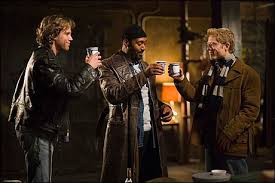
Right when
the three friends are starting on their Christmas Stoli, which Collins has once
again brought over, they hear Maureen’s frantic voice shouting up at them from
the street. When they all step out on
the fire escape to see what’s up, they are all shocked to see Maureen and Joanne
standing there, holding an extremely ill and barely-conscious Mimi. Without hesitation, the guys immediately run
outside and help Maureen and Joanne carry Mimi up to the loft, where they
quickly put together an improvised bed using an old blanket and the metal
table. (There was no room for her on the couch.) Mimi regains enough
consciousness to realize that Roger is right at her side. After Collins hands over his coat (which, in
a bit of movie trivia, is actually the same coat that Angel bought for him from
a street vendor earlier in the movie) to provide Mimi with an improvised
blanket, he runs over to the phone to call 9-1-1, leaving Roger to comfort
Mimi. As Mimi tries to tell Roger that
there was nothing between her and Benny, Roger insists that he already knows
and then begins to apologize for leaving, insisting that it wasn't because he didn't care about her. The weakened Mimi
cuts him off in mid-apology, stating that she already knows what he wants to
say, and then tells Roger that she loves him.
Roger,
visibly distraught over how ill Mimi has become since he’d last seen her, begs
her to hold on because there’s something she has to hear. He then proceeds to sing the song that he’d
written during his return trip from Santa Fe, which is entitled ‘Your Eyes.’ In this song, Roger tells Mimi he couldn't get
her out of his mind while he was off in Santa Fe, and that she had captivated
him from the moment she entered his life.
The song also states that Roger regrets letting her slip away, because
he’s always loved her. The moment Roger
makes his confession, Mimi’s body goes limp as she passes away. And for the record, this is the point in the
film when I started to cry. You might
find it weird that I cried at Mimi’s death when I got through the death of
Angel completely dry-eyed. In my
defense, I didn't find Angel’s character to be really fleshed out, so I didn't know that much about him/her before his/her death. It’s rather hard to shed many tears over
someone you knew next to nothing about.
That and, as I stated earlier, I felt the whole romance between Angel and
Collins practically came out of nowhere, which made it hard for me to be really
invested in their relationship. On the
other hand, Roger and Mimi’s relationship had been a primary focus through most
of the movie. We saw that romance go
through highs and lows, with their love being put through some rather serious
tests. So by the time we get to the
whole ‘Your Eyes’ scene, I was really rooting for these two to be together in
the end. The fact that these two
characters have come so far since the start of the movie only to have the girl
die right when they finally confess their love was simply crushing to me.
As Mark,
Collins, Maureen and Joanne keep a respectful distance, Roger sobs over Mimi’s
lifeless body. At that moment, Mimi’s
hand miraculously starts to twitch, and she somehow comes back to life. Needless to say, everyone is stunned to the
point of silence. As Mimi gets her
bearings, she explains to her reasonably confused friends that she was heading
to a warm, white light, but was stopped by Angel, who, according to Mimi,
looked good. Mimi then pauses and turns
to look directly at Roger, stating that Angel told her to turn around and
“listen to that boy’s song.” Roger
responds by choking back a sob and pulling Mimi close. Maureen, upon feeling Mimi’s forehead,
announces that her fever is breaking. As
the six friends rejoice in the fact that Mimi is now back with them, a jubilant
Mark strides over to his projector to showcase his finished documentary, which
he has entitled ‘Today 4 U,’ an obvious tribute to Angel. The documentary is revealed to be a testament
to everything the Bohemians had done throughout the past year. The movie ends with everyone watching Mark’s
documentary, relishing in their friendship and vowing to live by the mantra ‘No
Day But Today’ by not letting the fear of the future stop them from treasuring
the time they have together.
To this
day, RENT remains one of the most treasured movies in my DVD collection. I suppose it might be surprising that a movie
with no actual plot beyond simply following a group of friends throughout an
entire year would be so powerful and moving, but there are so many elements in
this story that makes it very possible. We've got a character struggling to overcome a serious drug addiction as
she tries to choose between the drugs and the man she loves, another character
who is still trying to come to terms with the knowledge that he has an illness
that will one day be fatal, yet another character who has to live with the fact
that his friends are slowly dying around him, two different romantic couples
who have their relationship tested due to their own insecurities and difficulty
in accepting each other’s faults, and a the very foundation of a seemingly
close-knit family is shaken when one of their number dies. What makes this story even greater is how
real the characters are. All the
characters in this story have their negative qualities. Not one character is perfect. Even the character of Angel, who is
frequently spoken of like a saint after his/her death, had some questionable
qualities. (Remember that Angel
practically killed someone’s dog and pretty much laughed about it
afterwards.) In spite of these negative
qualities, each character is still likable and someone you could even root for. These people might do some questionable things, but they're all still good people. Even Benny, who is virtually painted as a bad
guy, isn't a true villain. He’s trying
to work for the greater good, but his methods to accomplish that goal end up
creating an estrangement between him and his friends. The whole Benny vs. the Bohemians element
brings an interesting debate to the story.
Is Benny right, or are the Bohemians right? Is it better to hold true to your ideals or
to put more emphasis on receiving a steady paycheck? Could it be that both sides have a good
point, and the right answer is something in-between? What if there is no right answer? RENT leaves it up to us to form our own
conclusion.
As I've already stated, there are indeed some aspects in this story that are rather
strange when you think about them, whether it’s the musical lyrics, as is the
case with such songs as ‘Over the Moon’ and ‘I Should Tell You’ or issues with
the passage of time, like the fact that the life support meetings are being
held three days in a row in the beginning.
Of course, with the musical numbers, the oddness is pretty much
intentional for the reasons I covered earlier.
As for the time issues, this is simply due the obvious difficulty of
translating the stage musical into a movie format. And for the record, I do
admittedly prefer the movie version of RENT over the stage musical. While the stage musical is good in its own
way, I don’t think I would have followed the stage musical very well if I hadn't seen the movie first. (Others may feel the opposite, but I suppose all
RENT fans are inclined to prefer the version they saw first.) Besides, I think the movie version handled
the scene when Mimi dies and comes back to life far better than the stage
musical did. With the stage musical,
Mimi practically pops right up again like a jack-in-the-box, and her delivery
of the whole ‘I saw Angel and she looked good’ line almost comes across as a
joke. When Mimi comes back to life in
the movie, she still looks and sounds weak and lethargic, as one would expect
of someone who had been very sick moments before. That, and her delivery of the above-mentioned
line is much more believable.
Before I
finish this review, I probably should address this. As was already stated,
RENT is a stage-musical-turned-movie.
The original stage musical was the creation of an American composer and
playwright, Jonathan Larson. His intent
on creating RENT, which is considered to be his magnum opus, was to create a
musical inspired by Giacomo Puccini's opera, La Bohème. And for those of
you who have seen this opera, you will definitely see the parallels between
both stories, with one significant difference.
In the original opera, the character RENT’s Mimi is based on did not
come back to life. (After all, how many operas have a happy ending?) However, Larson
chose to alter the ending, as he wanted his musical to end with life rather
than death. While RENT started off as a
staged reading at The New York Theater Workshop in 1993, after a
three-year-long collaborative and editing process, the version of Larson’s
musical RENT that is now known worldwide was ready to be performed. Tragically, on January 25, 1996, the morning
of RENT’s opening night off-broadway, Larson died of an aortic dissection,
which is believed to have been connected to his undiagnosed Marfan syndrome. Despite his death, it was decided that the
show would be performed as-scheduled, and at the show’s conclusion, in the
silence that followed the applause, an audience member called out "Thank
you, Jonathan Larson." The identity
of this audience member is, to my knowledge, unknown, but I wholeheartedly echo
that sentiment.


